
Second Brain AI
Second Brain AI for Work That Does Not Start From Zero
Useful work creates context.
A conversation produces an idea. An email records a decision. Research answers a question. A document captures a plan. An AI discussion helps work through a problem.
Then time passes.
You remember that the information existed, but not where it lives. You remember the idea but not the exact wording. You know you solved a similar problem before, yet you still have to reconstruct the reasoning from scratch.
A Second Brain AI is designed around a more continuous way of working. Instead of treating every task or AI interaction as a completely new starting point, it can help make relevant previous context easier to find, revisit, and use again.
Surgy is being developed around the same broader principle: connect intelligence to the tools and information people already use without forcing them to replace those systems.
The goal is not to remember everything automatically. It is to make useful context easier to recover when it matters.
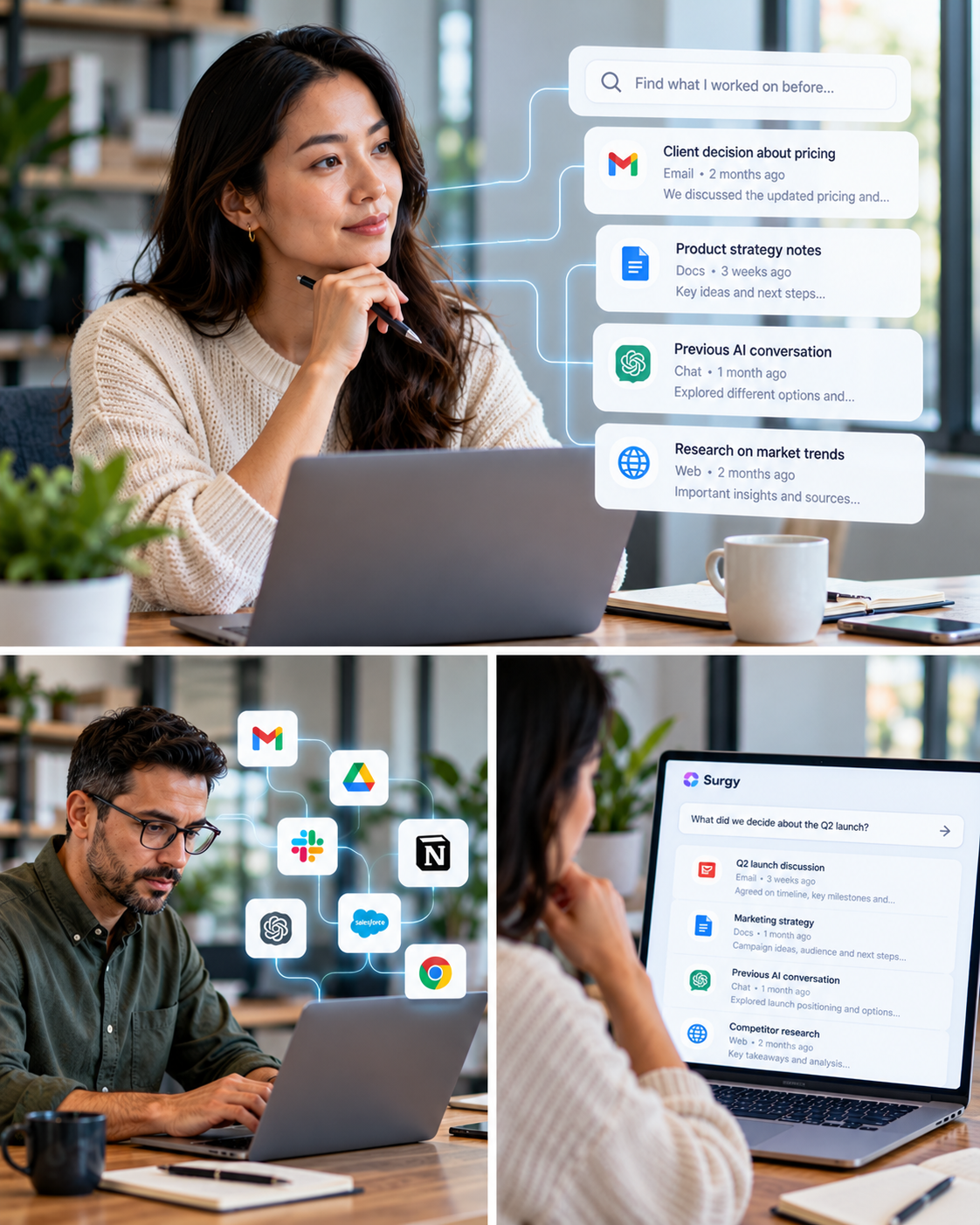

What Is a Second Brain AI?
A Second Brain AI is an AI-assisted system designed to help people reconnect with useful information from previous work.
Traditional note-taking and knowledge systems often depend on manual organization. Users decide what to save, where to store it, how to label it, and how to retrieve it later.
An AI-powered second brain can add another layer by helping users retrieve information based on meaning and context.
You may not remember the title of an old conversation, but you remember what was decided.
You may not remember the exact search phrase, but you remember the problem the research helped solve.
You may not remember where an idea was written, but you remember enough about it to describe what you need.
That makes contextual retrieval central to the second-brain concept.
The objective is not simply to store more information. It is to make previous work easier to continue.
Build Continuity Across Previous Work
One of the hidden costs of digital work is repeatedly rebuilding context.
A consultant returns to a client project and rereads old conversations.
A founder revisits an idea and tries to reconstruct the reasoning behind it.
A team member works through a problem that someone may already have explored.
A user asks AI about a subject they previously discussed but cannot find the earlier conversation.
Each situation creates the same problem: valuable work exists, but using it again requires another round of searching and reconstruction.
A Second Brain AI can help reduce that reset.
Instead of treating every task as isolated, relevant previous context can become easier to rediscover when a related question or project appears.
That does not mean every old piece of information should automatically influence new work.
Previous information can be outdated, project-specific, incomplete, or no longer appropriate. A useful AI memory system should make potential context easier to locate while allowing the user to decide whether it still applies.
The benefit is continuity without surrendering judgment.
Find Context Even When You Do Not Remember the Exact Words
Human memory does not always work like a search box.
People often remember meaning before wording.
You may remember that a client approved a change without remembering the email subject. You may recall an important discussion without knowing when it happened. You may remember an AI-generated idea without remembering the prompt that produced it.
Surgy’s AI Email Search already demonstrates this contextual approach within Gmail. AI-supported search can help narrow down relevant conversations based on meaning when exact senders, dates, subject lines, or phrases are difficult to remember.
A Second Brain AI assistant applies the same broader principle to continuity.
Instead of requiring perfect recall, the user can begin with what they remember:
- What did we decide about this?
- Where did I explore this idea before?
- Which previous conversation may be relevant?
- What information did I already find?
- What context should I review before continuing?
The original source still matters. AI can help shorten the path back to it.
Keep Memory Connected to the Tools You Already Use
A second brain becomes less useful if maintaining it creates another full-time organization task.
If users have to manually copy every useful email, document, note, conversation, and business record into a separate system, the new workspace can become another silo.
Surgy takes a connection-first approach.
Its business integrations are designed to work around supported systems rather than require businesses to abandon the software already responsible for their information and workflows.
That matters for AI memory.
Email can remain in the email platform.
Documents can remain connected to the systems where teams manage them.
Business records can stay associated with the applications responsible for those records.
The second-brain layer can then focus on helping users reconnect with relevant supported context rather than demanding that everything be manually recreated somewhere else.
This also keeps the source of important information clearer.
When exact wording, dates, commitments, financial details, or other consequential information matter, users should be able to return to the original system and verify it.
Turn Previous Information Into Useful Context
Finding something is not always the same as understanding it.
Imagine locating a long email thread from six months ago. Search solved the first problem, but the user may still have to reread several messages to understand what changed, which questions were answered, and what was ultimately decided.
Surgy’s AI Email Summaries address that second problem within email by helping users review the key context of longer conversations while keeping the source messages available for confirmation.
That distinction is useful for a Second Brain AI.
Memory is not simply an archive.
A useful second brain should help users reconnect with information in a way that supports the current task.
That may mean identifying a relevant conversation, recalling the context around a previous decision, or bringing related information back into view before someone continues working.
Search asks, “Where is it?”
A summary asks, “What happened?”
A Second Brain AI asks a broader question:
“What previous context may help me continue from here?”
Keeping those purposes distinct helps prevent the second brain from becoming just another search page or document repository.
Keep AI Memory Under Human Control
Long-term context can make AI more useful, but it can also make outdated information more influential if users do not review it carefully.
A previous note may no longer be correct.
An old recommendation may have been based on circumstances that changed.
Two sources may conflict.
An AI interpretation may miss an important qualification.
That is why Surgy uses an approval-first approach.
AI can help identify information, prepare recommendations, or suggest possible next steps while users retain responsibility for reviewing important details and deciding what happens next.
The same principle should apply to an AI context memory system.
AI can help answer:
“What previous information might matter here?”
The user should still determine:
“Is it correct?”
“Is it current?”
“Does it apply to this situation?”
A second brain should improve continuity without turning previous context into unquestioned truth.
Create a More Continuous Way to Work With AI
The practical value of a Second Brain AI is not perfect memory.
It is reducing how often useful work disappears from the next task.
Previous research can become easier to revisit. Earlier conversations can provide context for new questions. Decisions can be easier to trace back to their source. Useful work can remain connected to the tools where it originally happened.
For founders, executives, consultants, agencies, and other knowledge workers, that can create a more continuous relationship with AI.
Instead of repeatedly starting over, users can spend more time building on what they already know.
That fits Surgy’s broader direction: connect supported systems, make useful context easier to surface, and keep people in control of important decisions.
Explore Surgy’s connected business integrations to see how the platform works alongside existing systems, or join Surgy Early Access to follow the development of its connected AI capabilities.

Stop Starting From Scratch. Build on What You Already Know.
Your best ideas, conversations, and decisions shouldn’t get lost across disconnected tools. Discover how Surgy is developing a Second Brain AI experience that helps you reconnect with valuable context, revisit previous work, and move forward with greater clarity.
FAQ
What is a Second Brain AI?
A Second Brain AI is an AI-assisted system designed to help users reconnect with useful context from previous work, conversations, and supported information sources so they can continue without rebuilding everything from scratch.
How is a Second Brain AI different from a note-taking app?
A note-taking app generally depends on users deliberately saving and organizing information. A Second Brain AI can add AI-assisted retrieval and contextual search to help users find relevant previous information even when they do not remember its exact wording or location.
How is a Second Brain AI different from AI knowledge management?
AI knowledge management focuses broadly on organizing, retrieving, and working with information. A Second Brain AI places greater emphasis on continuity for the user by helping previous context become useful again in future tasks and conversations.
Can a Second Brain AI help find previous conversations?
It can when previous conversations or other information sources are supported by the system. AI-assisted retrieval can help surface relevant context based on meaning rather than requiring exact keywords.
Does a Second Brain AI replace existing business tools?
No. A connected Second Brain AI can work alongside existing software while helping users reconnect with relevant context from supported information sources.
Should information recalled by AI be verified?
Yes. Previous information may be outdated, incomplete, or interpreted incorrectly. Important commitments, financial details, deadlines, approvals, and other consequential information should be confirmed against the original source before being used for a decision.
Get Early Access to Surgy Second Brain AI
Discover a smarter way to reconnect with your previous work and valuable business knowledge. Join Surgy Early Access to stay informed about its developing AI memory, contextual retrieval, and connected workflows designed to help you find, review, and reuse relevant information across supported tools.