
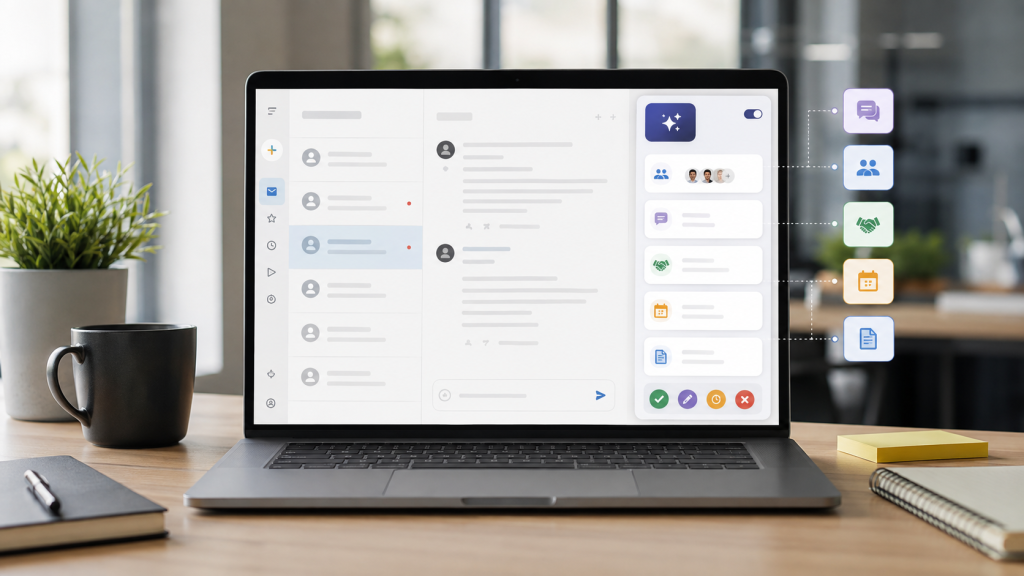
Remembering to follow up is not the same as remembering a conversation.
A useful follow-up depends on context: who is involved, what was requested, what has already happened, whether a response arrived, and what the next step may be. That is why simple reminders can feel disconnected from the actual work.
AI creates a different possibility. Instead of treating follow-up as a date on a calendar, it can help interpret supported communication as an ongoing business state.
For Surgy, that matters because AI Email is being developed to work alongside Gmail rather than replace it. The broader goal is to help important activity stay visible while people remain responsible for deciding what happens next.
That is the idea behind smarter AI email notifications and follow-up awareness: not remembering every message equally, but maintaining enough context to recognize when an important conversation may still need attention.
Follow-Up Memory Is a Context Problem
A reminder can preserve a date.
It cannot automatically preserve why the date matters.
Suppose a consultant sends a client three questions. The client answers two and says the third needs internal approval. A reminder created when the original message was sent may simply say, “Follow up with client Friday.”
By Friday, that reminder is already incomplete.
The consultant needs to know which question remains open, whether another reply arrived, what the client said about approval, and whether the situation still warrants a follow-up.
Useful email memory therefore requires more than storing the last message in a thread.
It needs to represent the state of the conversation.
That state might include:
- Who is expected to respond
- What information or decision is still outstanding
- Whether the conversation has changed since the last review
- Whether a deadline or commitment was mentioned
- What the user may need to decide next
AI can add value by helping evaluate supported text and context to identify the apparent meaning of a conversation, even when the wording changes.
The goal is useful memory: retaining enough context to help a person understand what may still be unresolved.
What AI Needs to Remember About a Follow-Up
A good follow-up system should not treat every sent email as a future task.
Most messages do not need another response. Some are informational. Some conversations end naturally. Others remain open because a question, decision, file, approval, or commitment is still outstanding.
To distinguish between them, AI-supported follow-up awareness can consider several types of context.
The Conversation
The thread itself contains the immediate history: what was asked, what was answered, and what may still be missing.
The People Involved
The same wording can mean different things depending on whether the message comes from a customer, colleague, vendor, prospect, or internal leader.
Commitments and Requests
Phrases such as “I’ll send that tomorrow,” “we need approval,” or “can you confirm?” can indicate that the conversation contains an unresolved expectation.
Timing
A date, deadline, meeting, launch, renewal, or other time reference can change how important a pending response becomes.
Connected Business Context
An email may relate to a sales opportunity, client project, customer issue, invoice, or operational task. When supported systems are connected, that surrounding context can help explain why the communication matters.
This does not mean AI should make the final decision about every follow-up.
It means the system can help assemble the relevant context so the user does not have to rebuild the conversation from memory each time.
Why Thread History Alone Is Not Enough
Email threads preserve messages, but preserving messages is not the same as preserving meaning.
A long conversation can contain dozens of replies, side questions, attachments, changed deadlines, and decisions made along the way. The latest message may not explain the full situation.
Imagine a customer thread that begins with a request for pricing, moves into a discussion about implementation, includes a revised timeline, and ends with the customer saying a manager must approve the next step.
The unresolved issue is no longer simply “customer has not replied.”
The useful memory is more specific: the conversation is waiting on internal approval for the revised next step.
That distinction matters because follow-up should be based on the current state of the conversation, not merely the age of the last message.
AI can help summarize supported context and identify open elements in a thread so users can review the situation more quickly.
This is also why waiting for replies should be treated differently from generic inbox monitoring. An incoming-message system asks what has changed. Follow-up memory asks what remains open after those changes are considered.
The result should be a clearer understanding of the conversation, not simply another unread-style counter.
From Memory to Useful Follow-Up Awareness
Remembering a conversation becomes valuable when the system can bring it back into view at a useful moment.
That does not require every unanswered message to generate an alert.
Useful follow-up awareness can be selective.
A system may help surface a conversation when supported context suggests that something important remains unresolved. It may provide a concise explanation of what is pending. It may help prepare a possible next step for the user to review.
The sequence matters:
- Understand the conversation.
- Identify the apparent open loop.
- Consider relevant activity and context.
- Surface the conversation when it may deserve attention.
- Let the user decide whether to act.
This is a better model than treating follow-up as an automatic timer.
It also explains the relationship between memory and AI email notifications.
The notification is not the memory itself. It is the moment when remembered context becomes useful to the user.
Without context, an alert is simply another interruption.
With context, it can help answer questions such as:
- What is still pending?
- Who appears to owe the next step?
- Why does this conversation matter?
- What changed since I last reviewed it?
- Do I actually need to do anything?
That is the difference between reminding someone that an email exists and helping them understand why it may deserve another look.
How Connected Context Changes Follow-Up
Email often represents only one part of a larger workflow.
A prospect may not have replied because a deal is waiting on budget approval. A customer question may relate to an unresolved support issue. A vendor response may determine whether an operational task can move forward.
If the relevant information lives in separate systems, users have to reconstruct the situation themselves.
This is one reason Surgy is being developed as an intelligence layer across the business tools people already use.
Its broader integration model is designed to connect communication with customer, operational, sales, and other supported activity. That means follow-up awareness can become more useful when email is understood in relation to the work surrounding it.
A message does not need to become a CRM record, project task, or accounting event in every case. The point is context.
When systems can be reviewed together, the user has a better chance of understanding whether an unanswered email is simply quiet or whether it is holding up something important.
The user can keep working inside familiar tools while AI helps bring relevant information together for review.
What Human-Controlled Follow-Up Should Look Like
Remembering every follow-up does not mean automatically sending every follow-up.
That distinction is essential.
Business communication depends on judgment. A message to a long-term client may need a different tone than a note to a new prospect. A routine vendor request may reasonably wait several days. A sensitive customer issue may need immediate human review.
AI should help with awareness and preparation without removing that judgment.
Surgy is designed around an approval-first model. The platform can identify activity, draft responses, prepare actions, and recommend next steps while allowing users to review what happens before execution.
Applied to follow-up, that creates a safer and more practical pattern:
AI helps remember the context.
AI surfaces what may still be unresolved.
AI can prepare a possible next step.
The user decides whether the follow-up is appropriate.
That model avoids two extremes.
On one side is completely manual follow-up, where every open conversation depends on memory and self-created reminders.
On the other side is uncontrolled automation, where a system may send messages simply because a timer or condition was triggered.
The more useful middle ground is assisted follow-up: stronger memory, better context, and human control.
A Better Model for Email Memory
The future of email memory is not a giant archive of everything that has ever been said.
People already have that in their inboxes.
What they need is help understanding which parts of that history still matter now.
A useful AI email assistant can help turn conversation history into current context: what is resolved, what may still be open, what changed, and what may deserve attention.
That is why follow-up memory belongs inside a broader intelligence layer rather than a standalone reminder list.
Surgy is being developed around that model. Users continue working with Gmail and other familiar systems while AI helps analyze supported activity, surface important information, and recommend possible next steps for review.
As Early Access capabilities evolve, the principle remains straightforward:
AI should help people remember the work hidden inside communication, not simply remember that an email was sent.
A better follow-up system does not ask users to keep every pending conversation in their heads.
It helps bring the right context back when it matters.
Join Surgy Early Access to explore how AI Email can add more context around the communication already moving through Gmail.
FAQ
Can AI remember which emails need follow-up?
AI can help evaluate supported conversation context and identify messages that appear to contain unresolved requests, decisions, commitments, or next steps. The exact follow-up capabilities available in a specific product may vary and can evolve over time.
How is AI follow-up memory different from a calendar reminder?
A calendar reminder primarily preserves a time or task. AI-supported follow-up memory can also consider available conversation context, such as what was requested, what has already been answered, and what may still be outstanding.
Does AI need access to other business tools to understand follow-ups?
Not every follow-up requires information from another system. However, connected business context can make some conversations easier to understand when an email relates to a customer, sales opportunity, project, payment, or operational process.
Does Surgy automatically send follow-up emails?
Surgy is designed around an approval-first model. AI can help identify relevant activity, draft responses, prepare actions, or recommend next steps while users remain responsible for reviewing and approving what happens.